
Metrics available in Team performance report
On all tabs within "Team performance report," you will find a question mark icon next to the name of each metric (in block headers and table columns). Hovering over it reveals a tooltip containing the metric's name, unit of measurement, timestamp, and a description of how the metric is calculated and what it includes.
In this article, we will break down the meaning of each metric, its unit of measurement, and timestamps (the exact time an event is recorded in the report).
In this article:
General statistics
Operators
AI bot
Folders
Support quality
Tags
Source
General Statistics
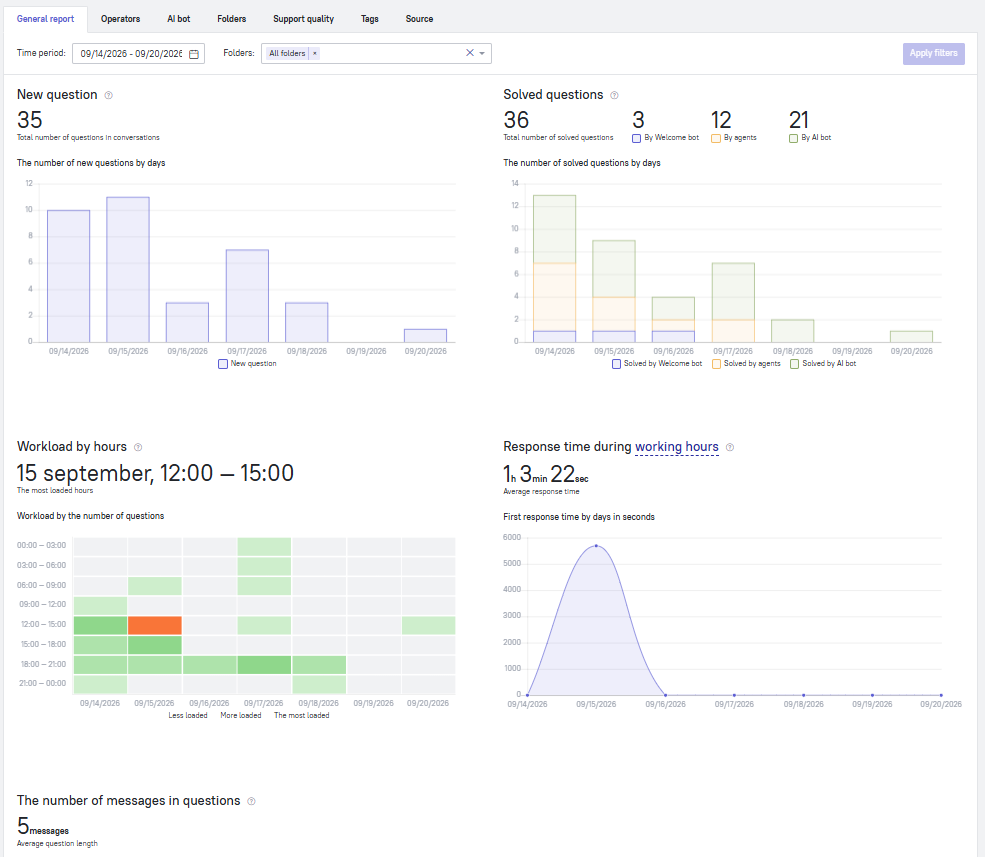
➨ New questions
Unit of measurement: New question
Timestamp: The date and time of the user's first message in the question (for conversations initiated by the welcome bot, this is the date and time of the user's first reply to the welcome bot).
A new question is created when:
An operator or a user writes to a closed conversation;
A user replies to a triggered message / a manual message from an operator, or writes for the first time via email/social media/messenger.
There can be multiple questions within a single conversation history. If an operator initiates a question by writing in a closed conversation, it will only appear in the statistics after the user replies. The moment the question is created and the moment it is recorded in the statistics will not match in this case. This also includes questions initiated by the welcome bot, they are added to the statistics starting from the user's first reply to the welcome bot.
➨ Solved questions
Unit of measurement: Solved question
Timestamp: The date and time the question was resolved.
The moment a question is considered "solved" depends on who closed it and how:
Support operator or AI agent intentionally closes the conversation: The general timeout from the inbox settings applies.
An AI bot or an operator closes the conversation due to user inactivity: The question is closed based on the timeout configured for the AI bot/specific agent. Once it expires, the conversation is closed immediately.
Conversations with the Welcome bot: These are closed immediately upon reaching the end of the scenario.
➨ Workload by hours
Unit of measurement: New question
Timestamp: The date and time of the user's first message in the question.
It shows the distribution of new questions by hour; however, unlike the "New questions" metric, this does not include conversations where communication occurs within a welcome bot scenario. If the selected period is longer than 7 days, the average value for all identical days of the week within that period is displayed for each hour.
➨ Response time
Unit of measurement: A question containing an operator's reply.
Timestamp: The date and time an operator's reply is required in the question.
Response time is the time from the user's first message in the question to the operator's first reply. If a bot replied before the human operator, the starting point is the moment the bot transferred the conversation to the agent. The breakdown into working and non-working hours is recorded at this exact moment and is not recalculated later; if you change your working hours settings, previous statistics will not change.
➨ Number of messages per question
Unit of measurement: Number of messages in questions
Timestamp: The date and time of the user's first message in the question.
Calculates the average number of all interactions within a question; not just visitor and operator's messages, but also internal notes, tags, assignments, and status changes. This includes questions where the user has left at least one message, regardless of whether the question is resolved at the time of calculation.
Operators
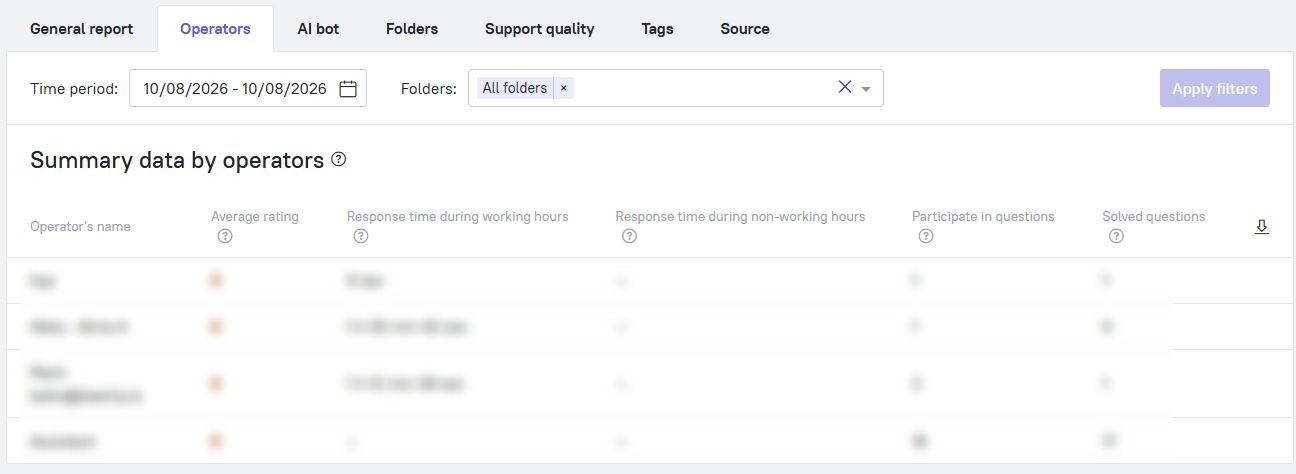
➨ Average rating
Unit of measurement: Rating
Timestamp: The date and time of the user's first message in the question
The rating is credited to all operators who replied in the question. A reply is an operator message or an article sent from the knowledge base, so what the customer sees. A note, an assignment, closing, snoozing or a tag do not count as participation.
If an operator has no ratings for the period, the table will show a rating of "0" - this can look like a very poor rating, even though there simply weren't any ratings.
➨ Response time during working / non-working hours
Unit of measurement: A question with an operator's reply
Timestamp: The date and time the question started waiting for an operator's reply.
Response time is the time from the user's first message in the question to the operator's first reply to it. If any bot replied in the conversation before the operator, the starting point is the moment the bot handed the question over to the operator.
The breakdown into working hours and non-working hours is fixed at this same moment and isn't recalculated afterward - if you change your working hours, statistics for past periods won't change.
➨ Participates in conversations
Unit of measurement: Question
Timestamp: The date and time of the user's first message in the question
Shows how many questions the operator sent a message to during the period. Note that leaving an internal note, assigning the conversation to themselves, closing it, snoozing it, or adding a tag does not count as participation. Both resolved and open conversations are counted. If multiple agents replied in a single conversation, it counts toward each of their totals.
➨ Solved questions
Unit of measurement: Solved question
Timestamp: The date and time the question was resolved.
The moment a question is considered "resolved" depends on who closed it and how:
- An operator or AI agent closed the conversation intentionally - the general timeout from the chat settings applies.
- An AI bot or agent closed the conversation due to user inactivity - they close the conversation using the timeout set for the AI bot / specific agent. When it expires, the question closes along with the conversation immediately.
A conversation is credited to an operator if they replied there. Leaving an internal note, assigning the conversation to themselves, closing it, snoozing it, or adding a tag does not count as participation
AI bot
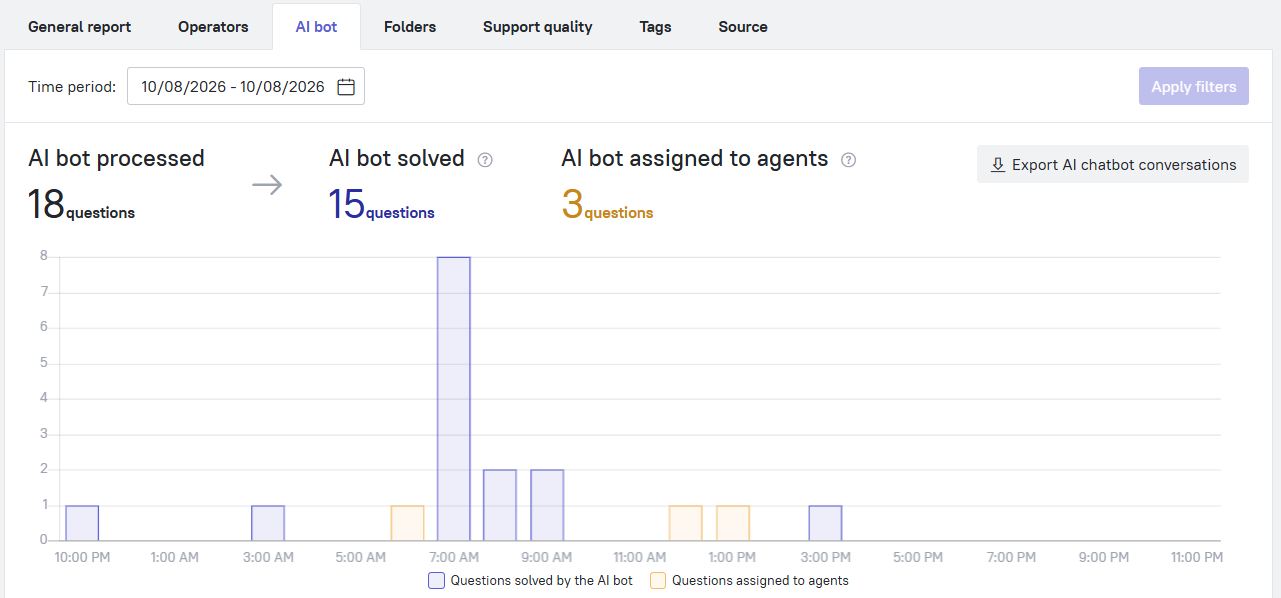
➨ Solved by AI bot
Unit of measurement: Questions resolved by AI bot
Timestamp: The date and time the question was resolved.
A conversation is considered resolved by the AI bot if the chat is closed without human involvement. The AI bot closes the chat due to user inactivity based on the timeout configured for the AI bot. Once it expires, the conversation is closed immediately.
➨ Assigned to operators by AI bot
Unit of measurement: Question transferred to an operator
Timestamp: The date and time the bot transferred the conversation to an operator.
Counts the conversations where the bot transferred the chat to an operator, regardless of whether the operator replied or when the question was resolved.
Folders
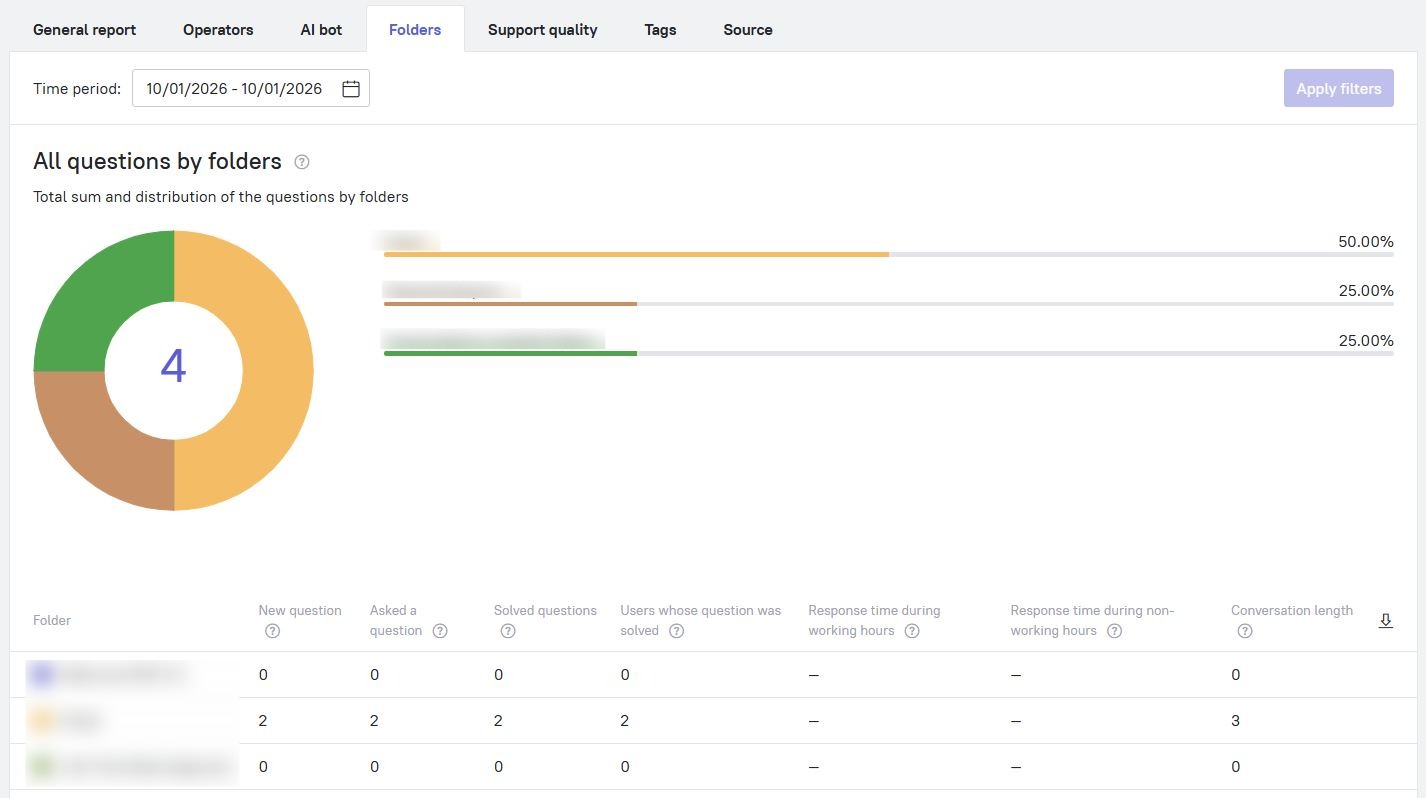
➨ All questions by folder
Unit of measurement: New question
Timestamp: The date and time of the user's first message in the question
Shows the distribution of new questions by folder, but unlike the "New questions" metric in General, this doesn't include questions where communication takes place within a Welcome bot scenario.
A question is counted in the statistics of the folder it's currently in - for already closed questions, that's the folder at the time of closing. If a conversation opened in one folder and closed in another, the question will show up in the final folder.
➨ New questions
Unit of measurement: New question
Timestamp: The date and time of the user's first message in the question.
Shows the distribution of new questions by folder, excluding conversations opened by the welcome bot. A question is counted in the statistics of the folder it is currently in. For already closed questions, this is the folder it was in at the time of closing.
➨ Users who asked a question
Unit of measurement: Unique user who started a question
Timestamp: The date and time of the user's first message in the question.
The question is counted in the statistics of its current folder. For closed questions, this is the folder at the time of closing, but it falls into a specific period's report based on the date of the user's first message, these two dates may not match. For example:
A user writes on January 30th, and the conversation goes to the "Sales" folder - the question will be included in the January report.
The conversation continues until February 5th, when an operator moves it to the "Tech Support" folder and closes it there.
In the January report, this user will be assigned to the "Tech Support" folder, even though they were practically in the "Sales" folder throughout January and were only moved to "Tech Support" in February.
➨ Solved questions
Unit of measurement: Solved question
Timestamp: The date and time the question was resolved.
A question is counted in the statistics of the folder it was in at the time of closing.
➨ Users with solved questions
Unit of measurement: User with a resolved question
Timestamp: The date and time the question was solved.
Each of a user's questions belongs to the folder it was in at the time of closing, not where it started. If a user has resolved questions in different folders, they'll be counted for each of them.
➨ Response time during working / non-working hours
Unit of measurement: A conversation containing an operator's reply.
Timestamp: The date and time the question started waiting for an operator's reply
The conversation is counted in the statistics of the folder it was in at the time of closing.
➨ Conversation length
Unit of measurement: New question
Timestamp: The date and time of the user's first message in the question
The conversation is counted in the statistics of the folder it was in at the time of closing.
Support Quality
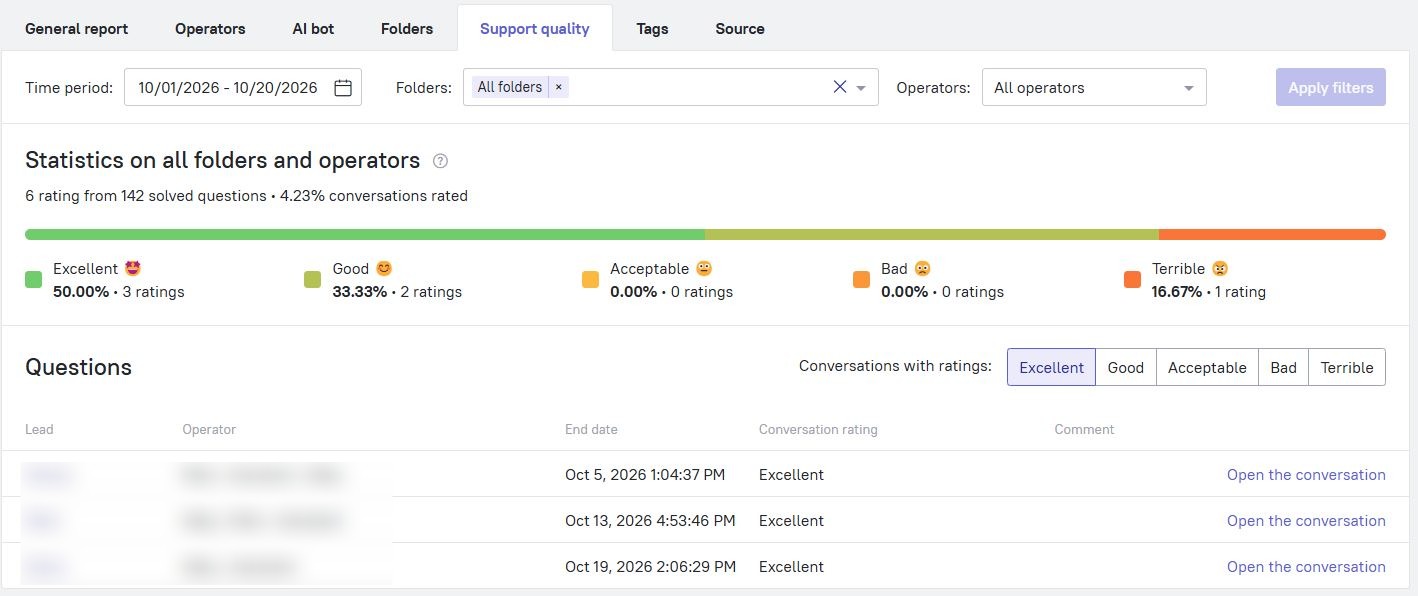
➨ Rating distribution
Unit of measurement: Rating
Timestamp: The date and time the question was resolved
A question enters the statistics by the date the question was resolved. This date may differ from the date the user actually gave the rating.
Unrated questions aren't included in the percentages, but are counted in the "rated X of Y" counter. Not everyone is asked for a rating: only after the conversation closes and a timeout expires, only in the website chat, and only if the question had enough messages, the threshold is lower for questions closed by a bot.
Tags
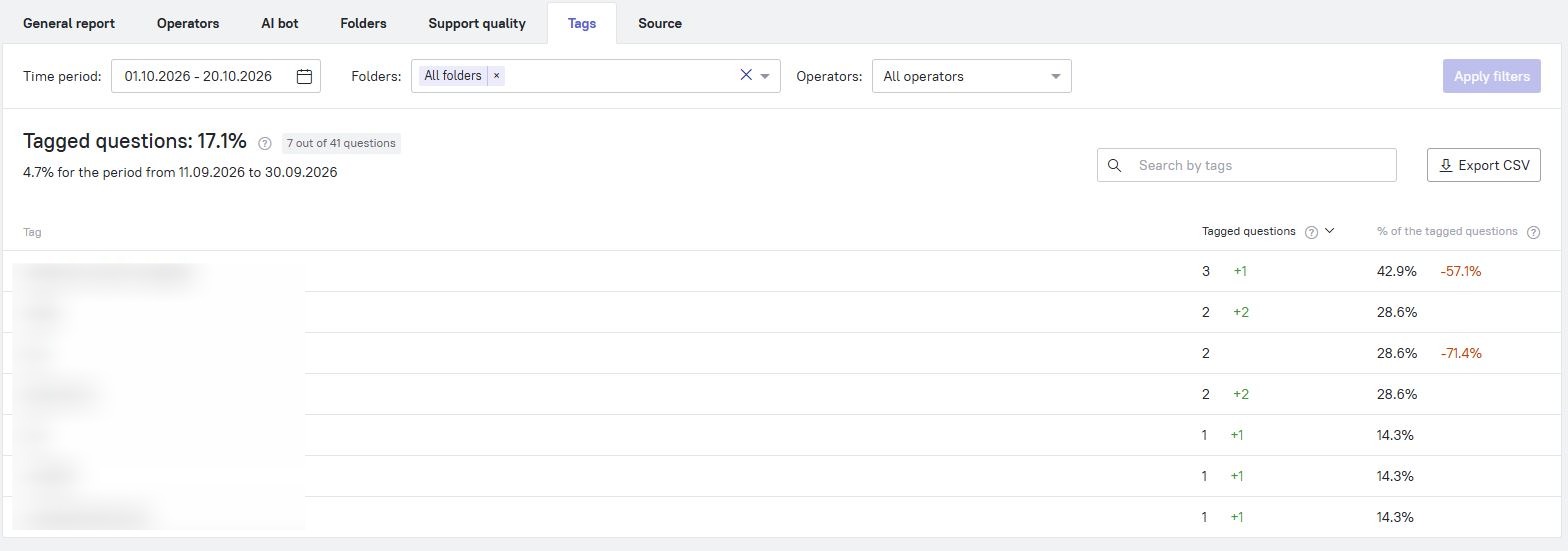
➨ Percentage of tagged conversations
Unit of measurement: Tagged question
Timestamp: The date and time of the user's first message in the question.
The percentage is calculated based on all questions during the period, both tagged and untagged. The value below shows the same percentage for the previous period of the same duration.
➨ Number of questions with a specific tag
Unit of measurement: Tagged question
Timestamp: The date and time of the user's first message in the question.
A tag is included in the statistics based on the start date of the question it was added to, not the date the tag was actually applied. If a question started several days ago and a tag was added only today, the tag will appear in the statistics for the period when the question started, not today.
➨ Percentage of tagged conversations (relative)
Unit of measurement: Tagged question
Timestamp: The date and time of the user's first message in the question.
The percentage isn't calculated from all questions in the period, only from those that have at least one tag.
Source
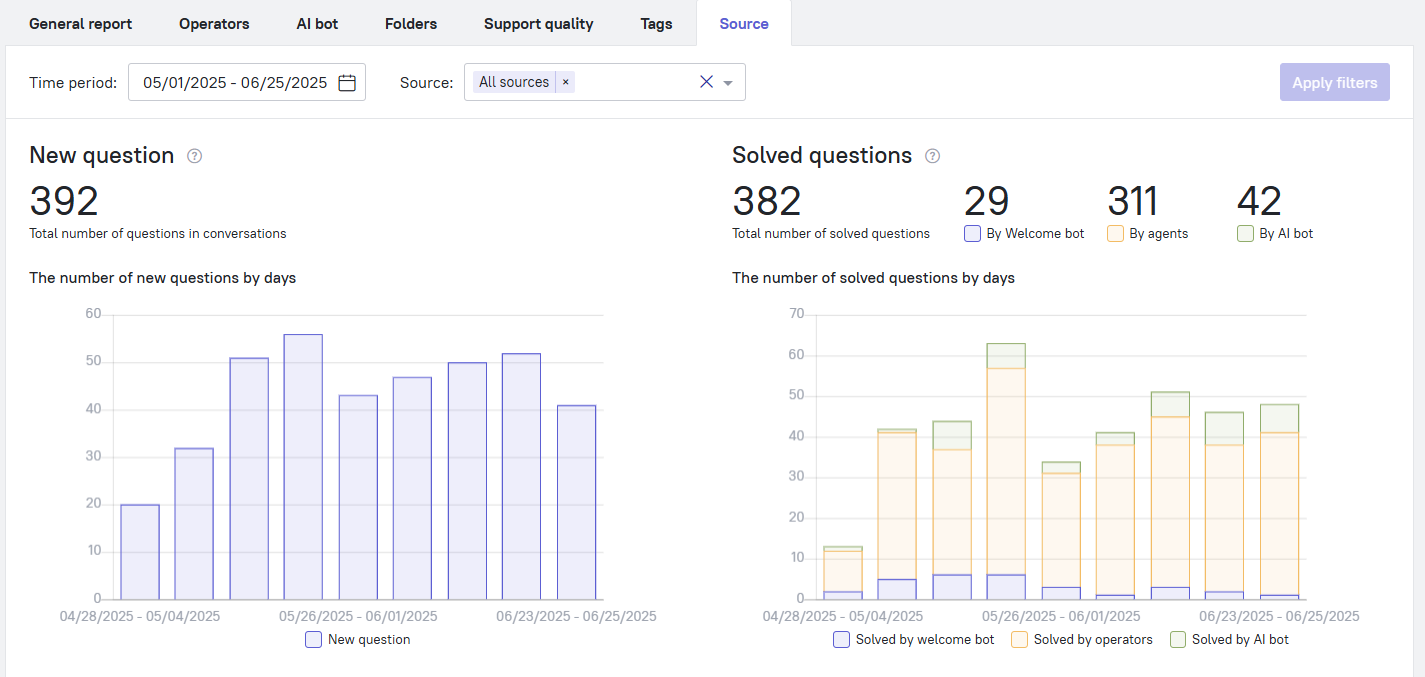
➨ New question
Unit of measurement: New question
Timestamp: The date and time of the user's first message in the question (for questions opened by the Welcome bot - date and time of the user's first reply to the Welcome bot)
➨ Solved questions
Unit of measurement: Solved question
Timestamp: The date and time the question was resolved.
The moment a question becomes resolved depends on who closed the conversation and how:
- An operator or AI agent closed the conversation intentionally — the general timeout from the chat settings is used.
- An AI bot or agent closed the conversation due to user inactivity — they close the conversation using the timeout set for the AI bot / specific agent. When it expires, the question closes along with the conversation immediately.
- Conversations with the Welcome bot close along with the question immediately when the scenario ends, without waiting for any timeout.